| Research – Straight Talk From Americans – 2000
A National Survey for the Pew Center for Civic Journalism conducted by Princeton Survey Research Associates.
As Americans enter a new century, they are evenly split over whether the nation is headed in the right direction, even as they are remarkably satisfied overall with daily life in their local communities. This satisfaction does not hide the problems the public sees around the nation and around their neighborhoods. There are troubling divisions among Americans in perceptions of their own lives, the problems they see and their dealings with key institutions. Those with lower incomes and less education see more problems and are substantially less satisfied than those with higher incomes and more education. Members of America’s minorities feel less safe and have dramatically less faith in the fairness of the local government, police and news media. Crime and violence and the decline of values are the top two national problems, even though no single issue dominates Americans’ concerns in this time of economic prosperity and relative peace around the world.
This poll for the Pew Center for Civic Journalism offered Americans the opportunity to list the issues most important to them, both at the national and local levels. A series of open-ended questions elicited free-form responses from the public about what is on their minds at the end of the decade. This approach allowed citizens to express their views without the filter of defining the problems to be discussed. After these free-form questions, more specific questions were included to focus on specific issues. This national survey of adults aged 18 and older was conducted on behalf of the Pew Center for Civic Journalism, an initiative of the Pew Charitable Trusts. A representative sample of 1,004 adults was interviewed by telephone during the period October 6 through October 31, 1999. For results based on the total sample, one can say with 95 percent confidence that the error attributable to sampling is plus or minus three percentage points. Results based on smaller subgroups are subject to a larger margin of sampling error. In addition to sampling error, the practical difficulties of conducting telephone surveys can introduce error or bias into their results. The State of Nation and Its Communities Americans are worried about the direction of the nation and are split in terms of overall satisfaction with the state of the union. Forty-eight percent say they are satisfied with “the way things are going in this country today”, while 44 percent say they are dissatisfied (Differences in survey findings are noted in this report only if they meet the criterion of statistical significance at the 95% level of confidence.) Eight percent do not know or refuse to answer. These numbers represent a marked improvement over only five years. In a March 1994 survey for the Times-Mirror Center, only 24 percent of Americans were satisfied with the direction of the country and 71 percent were dissatisfied. (A telephone survey for the Times-Mirror Center for the People and The Press, based on interviews with 2,001 adults, conducted March 16-21, 1994, under the supervision of Princeton Survey Research Associates.) This overall sense of satisfaction is tempered by differences of perception by gender, age, education and income.
This poll for the Pew Center for Civic Journalism offered Americans the opportunity to list the issues most important to them, both at the national and local levels. A series of open-ended questions elicited free-form responses from the public about what is on their minds at the end of the decade.From the national perspective, the public is worried about moral issues, construed with a broad brush. Crime, a decline in the family, a lack of moral leadership and similar concerns reverberate through the population. One top issue mentioned by the public clusters around the topic of crime, violence and illegal drugs. These issues are named by 15 percent of the public. (This number is down substantially from the 32 percent who named this cluster of issues as the most important issue in a 1994 survey.) (A telephone survey for the Times-Mirror Center for the People and The Press, based on interviews with 2,001 adults, conducted March 16-21, 1994, under the supervision of Princeton Survey Research Associates.) Generalized comments about a moral decline in the nation, a lack of values, a failure to embrace religious values are mentioned by 14 percent of the public. A significant subset of these concerns focuses on the moral decline of the family and the failure of the family structure. This category of moral concerns is up from 10 percent in the 1994 survey.
“Nobody puts any value on morals anymore. The country has moved away from our basic family values.”
Issues involving children and teenagers are named by eight percent, with a heavy concentration in those comments on issues of morality, a lack of respect and out-of-control behavior by those who are not yet adults. Another eight percent mention problems with politics and politicians. This cluster of issues also has a moral tone: a lack of national leadership and the failure of politicians to set a moral example. Five percent mentioned this in 1994. With the economy booming along with low unemployment and low inflation, matters relating to money are mentioned by about 10 percent of the public. These comments range from calls for lower taxes, to a focus on the unemployed, and to those who say that prices are rising and everything still costs too much. Education is also high on the list of problems, with eight percent of the public mentioning education. Eight percent also mention other issues related to children and teenagers. No issue is mentioned as the most important one facing the nation by more than 15 percent of the public. The issues that are mentioned range widely, from the economy to poverty to foreign policy. (See Table 1.)
Looking at perceptions of national problems, there are some variations across demographic groups.
Looking at the communities with another yardstick, more than eight in ten Americans give excellent or good ratings to the area where they live. Nearly one-third (32%) rate their community excellent as a place to live. About half (51%) rate their local community as good. Just 13 percent rate their community as only fair and three percent rate it as poor. Within these high levels of satisfaction, there are variations, particularly by race and by location.
Looking at the question of rating the community on a scale of excellent to poor, additional variations appear.
“We’re growing faster than the facilities and things that were put here years ago are able to handle”.
At the local level, Americans’ concerns are much more related to their everyday lives than is the case when discussing national issues. The complex of issues known as sprawl, growth, traffic, roads and infrastructure are a top concern, with 18 percent mentioning the issue. (See Table 2.) This cluster of issues is quite diverse, but all focus on the impact of growth and development on the daily lives of individuals. Whether it is traffic congestion, poorly-maintained roads, inadequate sewer and water or crowded schools, all the complaints focus on the quality of life that is endangered as the local infrastructure fails to keep pace with growth and development. (This complex of issues drew mentions from 13 percent of Americans in the 1994 poll.)
Sprawl is more of an issue for those in the suburbs than anywhere else, more of an issue for college-educated citizens and more of an issue among white Americans than African-Americans. And it is a huge issue in Denver and San Francisco.
Crime and violence are just as important an issue at the local level as sprawl, with 18 percent mentioning it as well. Thus, crime is at the top of Americans’ list of big problems at both the national and local levels. (Crime and related issues were the top local problem mentioned by 29 percent in the 1994 poll.)In terms of demographics, this complex of issues is almost the flip side of sprawl.
Concern about crime is highest among the youngest Americans. About one in four Americans under age 35 (24%) mention crime as a local problem, compared with only one in nine among those age 65 and over (11%). Asked in a direct question about how big a problem crime, drugs and violence are in their communities, Americans put it at the top of the list of seven specific issues. Seventy-nine percent say crime, drugs and violence are a problem, with 32 percent calling them a big problem. Only 19 percent do not see these as a problem in their community. Again, crime is a concern across all groups, but the intensity of the concern does vary.
The concern about crime is real, but Americans still feel safe at home and in other familiar locales.Ninety-six percent of those questioned say they feel very safe or somewhat safe at home at night. Eighty percent say they feel equally safe walking around their neighborhood at night. Despite recent tragedies at schools, 73 percent say that they feel they and their families are safe at school. And nearly as many, 70 percent, say they feel safe at the shopping malls at night. (These findings are quite similar to those from a 1993 poll, showing substantial feelings of safety in various situations. Telephone survey for Family Circle Family Index Project, based on 2,004 interviews of adult heads of households, June 1-June16, 1993 by Princeton Survey Research Associates.)
These high levels of feeling safe at home stretch across groups, but there are variations in the degree of safety that various demographic groups report.
Similar patterns are apparent when people are asked about their sense of safety while walking in their neighborhoods after dark.
Going to shopping malls at night may be a common experience for many Americans, but there are variations in the feelings of safety in such situations.
At school, those with the most recent direct experience – parents of school age children and younger Americans – often feel safer than others.
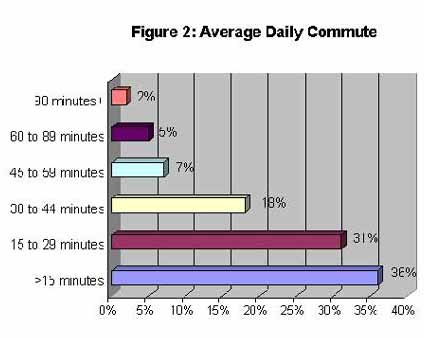
Not only are these problems high on the list of the problems that the public talks about without prompting, these issues are labeled big problems across the nation in other ways. Asked whether traffic congestion is a problem “in the community where you live”, 35 percent of the public says it is a big problem. Almost as many, 30 percent, say it is a small problem. About a third (34%) say traffic congestion is not a problem where they live. There are major variations by city on these questions. For example, 73 percent of Denver residents and 68 percent of San Francisco residents call traffic congestion a big problem, compared with 44 percent of Philadelphia residents. The Daily Grind To anyone who has sat in rush hour traffic in Los Angeles or who has tried to take a bus across Peoria, Illinois, it should come as no surprise that Americans say they spend so much time in their cars. Nearly nine out of ten American workers (88%) commute to their jobs on an average day. Only five percent report taking public transportation to work. What may surprise some is that two-thirds of workers report their daily one-way commute is less than half an hour. For just over a third of the workers (36%), the commute takes less than 15 minutes. For another third (31%), the daily commute lasts 15 minutes to just under half an hour. But for 25 percent of the workers, travel to work lasts 30 minutes to just under an hour. And for seven percent of all workers, the commute is an hour or more each and every workday. (See Figure 2.)
The average commute is going up. A 1993 survey for Family Circle magazine found 42 percent saying the daily commute was less than 15 minutes; 31 percent saying 15 to 29 minutes; 20 percent saying a half an hour to 59 minutes and 5 percent reporting an hour or more each day. (Telephone survey for Family Circle Family Index Project, based on 2,004 interviews of adult heads of households, June 1-June16, 1993 by Princeton Survey Research Associates.) And one would not be surprised to find out that the longer the commute, the more likely one is to say traffic congestion is a big problem. Among those who commute less than 30 minutes a day, 35 percent say that traffic congestion is a big problem. But among those whose commute lasts an hour or more each day (a small group nationally), 53 percent say it is a big problem. As one would suspect, concern about traffic congestion is concentrated in the big cities and suburbs. Fifty-one percent of those living in big cities say traffic congestion is a big problem, and 46 percent of the suburbanites agree. Only 18 percent of those in rural areas report a big traffic problem. Those who say traffic congestion is at least a small problem were asked to pinpoint the cause of the problem. The answers reflect the lack of a consensus on the reasons, one stumbling block to solving the problem. Forty-four percent say that the reason is simple population growth in the area. Twenty-one percent blame a lack of adequate planning. Fifteen percent say not enough money has been spent on highways and transportation and 13 percent say over-development. Six percent are not sure. Looking at the cluster of issues from another angle, 28 percent of Americans say that too much growth and development is a big problem where they live. Twenty-seven percent say that it is a small problem. Forty-three percent say it is not a problem. As one would suspect, the suburbs are the focus for this perception.
The issues of growth and development are bedeviling local and state officials across the country, in large part because there is a substantial division over how to deal with the problems. This split is evident in the answers to a question how local government should use its power to focus growth. A bare majority of the public (52%) agree that “local government should continue to plan for and encourage growth and new development in all areas.” But a strong 40 percent agree that “local government should try to limit growth in less-developed areas and encourage growth only in areas that are already built up.”Report continued in National Part Two…
[Table of Contents] [National Report] [Tampa Report] [Philadelphia Report] |
||||||||||||||||||||||||||||||||||||||||||||||||||||||||||||||||||||||||||||||||||||||||||||||||||||||||||||||||||||||||||||||||||||||||||