


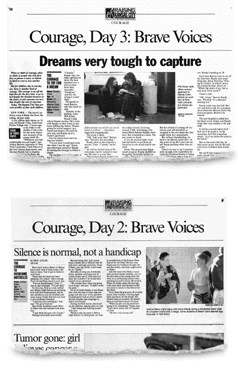
| In Kansas City, the Star enlisted 12 prominent citizens — including academics, theologians, and physicians — to choose the “core values” important to raising the community’s young people. (IMAGE 38K) |

Civic journalism doesn’t just happen. Involving citizens in the coverage of community issues takes planning, allocation of scarce newsroom resources and a commitment to the long haul. Consequently, most efforts are neither cheap nor easy.
The process usually begins with a perceived community problem: persistent crime in particular neighborhoods, young people who seem to be morally adrift, jobs that have evaporated.
From that perception comes an idea for a newspaper’s coverage, an idea that treats readers as participants in the process and not just as passive spectators. To begin, the idea is tested with the citizens themselves (“Is this a problem and do you want to help us search for solutions?”) and then framed in terms readers can best relate to.
Citizen involvement at every stage characterizes the coverage. Not only does the newspaper put forth its best reporting and writing covering the “problem,” it also encourages and covers extensively citizen input and participation. How the community responds becomes an essential part of the story.
ASSESSING A COMMUNITY’S NEED
How do editors decide whether a local issue is worth the commitment required of a civic journalism initiative? Most begin by asking their readers. “Asking” can be done in many ways: polls, focus groups, panels of experts, panels of citizens, community forums, solicitations printed in the newspaper. In the end, the decision is the editors’, but citizen input is essential from the very beginning.
| The Star followed through by publishing comprehensive packages on each value. | |
The Panel’s Values:
|
|
|
||
|
||
|
||
|
||
|
||
|
||




TESTING THE IDEA
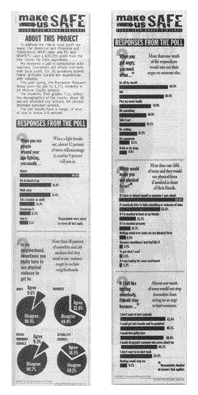
| Crime was the topic in St. Paul. To help its reporters and editors better understand how attitudes and experiences differ from place to place across the Twin Cities, the Pioneer Press conducted an extensive telephone poll (2,853 adults) that provided data not only for the region and its two largest cities, but also for six specific neighborhoods. This initial research enabled the newspaper’s reporters to analyze important neighborhood differences. (IMAGE 32K) |

Simply raising an alarm about a problem (“crime is a blight in our city” or “the economy is in trouble”) is traditional journalism, but often insufficient to engage citizens. They don’t find in such coverage anything they personally can do about the problem. Civic journalism demands that we go further by exploring how the community can actually begin to deal with the problem.
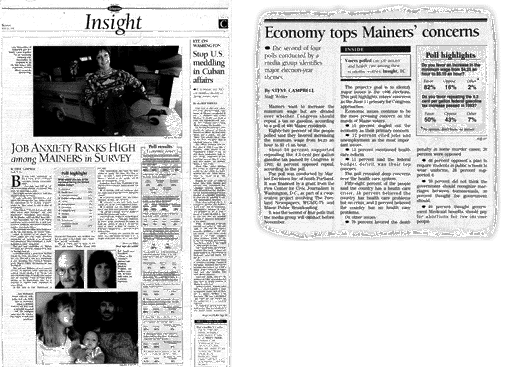
| As part of their election coverage, The Portland Newspapers with WGME-TV (CBS) and Maine Public Broadcasting conducted a series of statewide polls to help discern voter attitudes about the issues in the 1996 campaign and to help frame year-long discussions for a group of Sanford citizens. (IMAGE 64K) |
As a result, the newspaper goes back to the readers in many ways — to field test the premise, to gather more data, to deepen the understanding of the journalists by putting them in closer touch with citizens. The objective is not to “solve” the problem; it is to use citizens to help produce better coverage as the news organization works toward reporting the problem in ways that will connect with citizens.
|
||
|
||
|
||


FRAMING THE COVERAGE
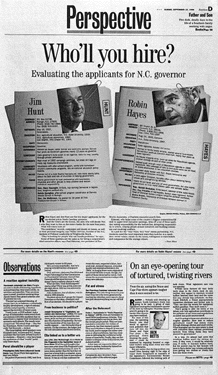
| In Charlotte, The Observer constructed “resumes” for each gubernatorial candidate. And it framed the races for governor and senator as hiring decisions for the voters. (IMAGE 39K) |
How you frame a question often determines the nature of the answer. If you see a story in terms of a contest, with two sides of an issue squaring off in public view, the narrative will fill that adversarial frame. But often other voices need to be heard.
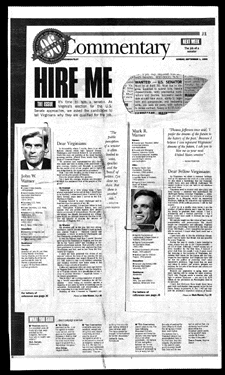
| In Norfolk, The Virginian-Pilot asked senatorial candidates to “apply” for the job by submitting a resume and application letter outlining their qualifications. (IMAGE 38K) |
Civic journalism seeks to broaden the frame on many news stories, to give other parties a voice on an issue, and to give readers and viewers a sense of what their role is. Adjusting the framing usually requires adjusting the master narrative; often it ends up less conflict-driven.
Election campaigns, for example, also can be covered as job interviews with the candidates, not just as contests that some will win and others will lose. Doing so helps citizens more clearly understand their role in election campaigns and see the overall process in a slightly different way.
| Pausing to think about framing can help shape coverage of a breaking story that otherwise might be driven by opponents on an issue. In Charlotte, a tax supported theater company produced a play containing frontal nudity. It didn’t take long for battle lines to form. The mayor and a coalition of conservatives were offended by the performance and wanted it closed; civil libertarians defended artistic freedom. The Observer polled 400 readers to put some different players into the drama — citizens of Mecklenberg County — whose views on nudity and tax-supported works of art helped inform and elevate the community dialogue. (IMAGE 36K) |

Effective framing sets a direction and tone for a project by bringing key stakeholders — parents, teenagers, voters, the community’s disenfranchised — into different focus.
Telling the story from a particular point of view can make a difference. In Duluth, Minn., the News-Tribune chose to frame a series on violence by concentrating on men, especially how they learn and sustain violent behavior. In Detroit, the Free Press told the story of teen violence through the eyes of the teens themselves. In Kansas City, the Star framed the challenge of raising children around key values.
|
|||
|
|||

EXPLAINING THE PROJECT
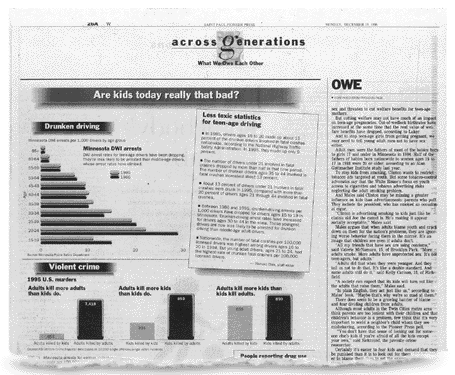
| In St. Paul, editors and reporters on the “Across Generations” team published a list of their goals for the project. Among them, to “demonstrate that we do owe something to each other and to show readers how they can fulfill obligations.” The team also invited readers to “let us know how you think we’re measuring up.” (IMAGE 32K) |

In all civic journalism projects, two things need constant repetition: inviting citizens to participate and telling them what you’re up to. Citizen participation is a defining feature of civic journalism; the rationale is that citizens can help journalists do better journalism and citizens can help their community with their active participation. Because that is a novel approach for many newspapers, however, readers need constant reminders of what the projects are about and of their part in the process.
|
||
|
||

