“This is an archived site of work by the Pew Center for Civic Journalism from 1994 to 2002. More about the Pew Center here: [About the Pew Center]. The Pew Center spun into J-Lab: the Institute for Interactive Journalism in 2002. [Home]. For more information, contact: [J-Lab ]”

This is an archived site of work by the Pew Center for Civic Journalism from 1994 to 2002. More about the Pew Center here. The Pew Center spun into J-Lab: the Institute for Interactive Journalism in 2002. For more information, contact us.

EXPLORING THE LAYERS OF CIVIC LIFE.


Exploring the Layers of Civic Life


Here are key insights into the layers and dimensions of a community’s civic life. These insights are drawn from the Wichita work and from other Harwood Group projects.


INSIGHT #1

AT LEAST FIVE DISTINCT LAYERS OF CIVIC LIFE EXIST IN A COMMUNITY.

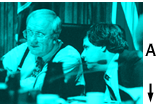
A. OFFICIAL.
The layer of official politics and institutions in a community. People in the community engage this layer through such places as city council meetings and public hearings.

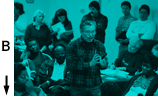
B. QUASI-OFFICIAL.
The layer made up of organizations and people who are involved with, for instance, citizen associations, local municipal leagues, advocacy groups and others.

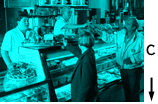
C. THIRD PLACES.
The layer of civic conversations and spaces where people gather to talk and do things together. Third places include churches and synagogues, community socials, barber shops, diners, child care centers.

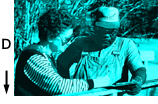
D. INCIDENTAL.
The layer of civic life where people interact informally on sidewalks, at the market, in backyards. Here people bump into one another.

E. PRIVATE.
The layer that occurs in the privacy of people’s homes.

 Journalist’s Challenge

When journalists venture into civic life, often they gravitate to the official and private layers. Then when they want more sources, they expand the number of people within those layers.

Even when seeking sources beyond the official and private layers, journalists tend to tap into the quasi-official layer. But leaders in this layer (and even many citizens) often do not accurately reflect the voices and perspectives within a community. Increasingly, quasi-official groups are facing the same complaints of being as disconnected from citizens as are official institutions.


READ THE NEXT SECTION OF THE WORKBOOK — LAYERS OF CIVIC LIFE

BACK TO TABLE OF CONTENTS