March 3, 1994
Health Care Reform on Trial
Approximately 50 participants.
In a mock trial in front of a circuit court judge, a jury of eight Wisconsin citizens
heard "testimony" on four national health care proposals from two congressmen, a state
legislator and an economist from Washington, D.C. After questioning the four experts,
the jury went off and deliberated. Their verdict was in favor of the single-payer
system.
Lesson: Preceding the "trial" with a statewide poll on health care solutions helped
to frame a more useful discussion. The poll also provided names of potential
participants that were used to help build an audience that reflected the state's
demographics.
Spring 1994
We the Young People
Approximately 165 participants.
This series of programs targeted high school students nearing voting age in an effort
to give them a voice -- and an interest -- in the political process. In mid-April,
students at three high schools were asked to fill out surveys about the most important
issues facing them and their greatest concerns about the future. Similar surveys were
sent to lawmakers to see what they thought was important to the teenagers of
Wisconsin.
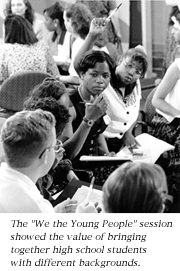
During late April and early May, town hall meetings were held at high
schools in La Crosse, Edgar and Milwaukee, using the survey results as a guide. On
June 15, a total of 50 students met in a State Capitol room in Madison for a live
90-minute broadcast. The goal: to narrow the list of concerns and issues into a short
agenda that could be presented to candidates for statewide office. Several students
were invited to ask questions at the fall U.S. Senate and gubernatorial debates.
Lesson: There was real value in bringing together young people of different
backgrounds; they talked to each other and have carried on the relationship.
Results: The sessions opened a dialogue with elected officials, who were surprised to
learn that young adults have the same concerns as their parents.
Results: While watching the town hall meeting, Kevin Miller, a consultant with the
Department of Public Instruction, realized the state needed to educate students about
employment options that did not require a four-year degree. Miller promised to work
with state legislators to follow up on the students' concerns about getting into
college, paying for it and then finding jobs.
October 1994
Campaign for Governor
Town Hall Meetings/Debate
Approximately 450 participants in six different locations.
Perhaps the most complicated event since the multistate presidential-candidate debate,
the focus on the governor's race between Republican incumbent Tommy Thompson and
Democratic challenger State Sen. Chuck Chvala started with October town hall meetings
in Marathon County and Milwaukee. Another town hall meeting preceded the October 17
debate, held at the University of Wisconsin in Green Bay. Three smaller town hall
meetings took place that night in Beloit, Racine and Eau Claire; all three took part
in a post-debate discussion on Wisconsin Public Radio. Eau Claire was able to
participate in the Green Bay debate through a video satellite feed. John A. Rapp, a
Beloit College political science professor who served as facilitator for the Beloit
town meeting, said, "Above all, people really appreciated how seriously their ideas
and input were taken by the radio hosts and how much autonomy they had to jump in with
their ideas."
Results: A citizen found an opportunity to ask one of the best questions of the
campaign: Would the candidates deliver their property tax plans, in writing, before
the election? Said Iverson: "It showed how citizens can demand a different kind of
accountability than reporters can."
Results: Drawing on their summer experience, teenage participants from "We the Young
People" took on the candidates. Greg Toliver, a black senior from Milwaukee, and Libby
Soczka, a white senior from Edgar -- two people who otherwise might never have met --
together asked the same question about crime: How would the candidates make them feel
safe in their own neighborhoods? Later, Chvala met with Toliver in Milwaukee.
Fall 1994
Campaign for Senate.
Approximately 50 participants.
Iverson incorporated the "We the People" approach into the August 19 edition of his
weekly magazine show, Weekend, on Wisconsin Public Television. He invited three "We
the Young People" participants to the television studio as panelists during a
mini-forum with the four candidates for the Republican U.S. Senate nomination.
The partners planned a full-fledged "We the People" town hall meeting/debate between
the GOP and Democratic candidates, but incumbent Herb Kohl declined to participate.
Undaunted, the partners turned the proposed debate into a 60-minute election
special produced live on October 28 in front of a 50-member studio audience and
simulcast on Wisconsin Public Radio and Wisconsin Public Television. The participants
and callers from around the state questioned Republican challenger Robert Welch for 25
minutes. The rest of the program included voter education pieces on ad-watching and
property tax plans then concluded with a 12-minute "Talk Back to Journalists" segment,
featuring a political writer from Milwaukee, the editor of the State Journal and the
editorial director of WISC-TV.
Lesson: Kohl's decision not to participate prompted the partners to form a new policy:
Candidates are now told a candidate forum will be held even if they decline to
participate. The partners also learned that having a good track record doesn't ensure
candidate participation.


wideredline-left.gif)
wideredline-right.gif)
redline-left.gif)
redline-right.gif)
civicjourn1.gif)
civiccat1.gif)
pubs1.gif)
videos1.gif)
speeches1.gif)
research1.gif)
conf1.gif)
spotlight1.gif)
pewproj1.gif)
batten1.gif)
aboutpew1.gif)
search1.gif)
sitemap1.gif)